What Is the 5-4-3-2-1 Packing Method?
August 22, 2026 · 4 min read
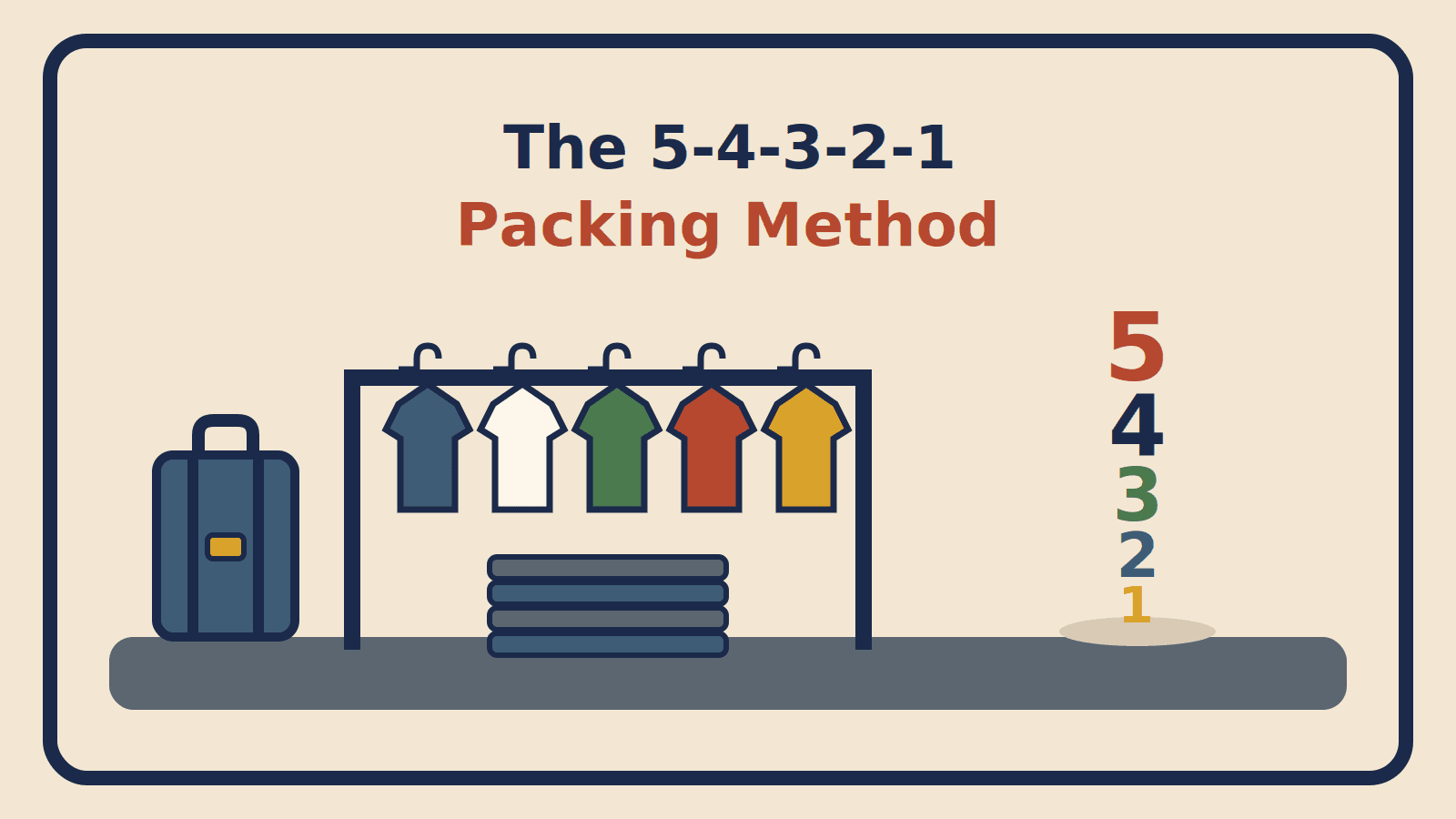
The 5-4-3-2-1 packing method is a formula for building a small travel wardrobe: roughly 5 tops, 4 bottoms, 3 pairs of shoes, 2 accessories, and 1 extra piece, all sharing one color palette so almost any top pairs with almost any bottom. The exact category labels shift depending on where you read it, but the underlying idea, a fixed small count that multiplies into many outfits, stays the same.
Quick Answer
- 5 tops, 4 bottoms, 3 pairs of shoes, 2 accessories, 1 extra piece, in one shared color palette
- Produces roughly 20 unique top-and-bottom combinations from just 9 clothing pieces
- The exact category order varies by source, with shoes and layers commonly swapped between positions
- Works best for trips of about one to two weeks, assuming a laundry stop or wash midway
- The ratio matters more than the specific labels attached to each number
Why the Ratio Works
The mechanism behind 5-4-3-2-1 is simple multiplication. Five tops paired against four bottoms produces twenty possible top-and-bottom combinations before a single shoe, jacket, or accessory changes how any of them reads. That's the entire point of the method: a small number of pieces, chosen specifically because they coordinate, produces far more visual variety than the same volume of unrelated items would.
The constraint that makes this work is the shared palette. A method that says "bring five tops" without also saying "in colors that all match each other" doesn't actually deliver the multiplication, since a floral top and a graphic tee don't combine with the same four bottoms the way two solid-color tops do. Every version of 5-4-3-2-1 that holds up in practice leans on neutral or coordinated colors doing the real work, not the raw item count.
Common Mistakes
People assume the five categories in 5-4-3-2-1 are fixed and universal. In practice, sources disagree: some count 5 tops, 4 bottoms, 3 layers, 2 shoes, 1 accessory set, others swap shoes and layers, and at least one version replaces accessories with dresses entirely. Treat the numbers as a ratio to adapt, not a spec to follow to the letter.
People pick pieces they like individually, then discover they don't actually combine. In practice, the method only works if every top is chosen against the four bottoms it needs to pair with, and vice versa, which means picking the bottoms first and building tops around them tends to work better than the reverse.
People assume the method scales linearly for longer trips by just adding more of everything. In practice, most versions of 5-4-3-2-1 are built for trips of roughly one to two weeks with a laundry stop, and simply multiplying every number for a three-week trip usually reintroduces the overpacking the method was designed to avoid.
Where the Numbers Actually Disagree
The core disagreement is worth stating plainly rather than picking one version and presenting it as definitive. A men's style outlet lists the categories as 5 shirts, 4 bottoms, 3 accessories, 2 pairs of shoes, and 1 extra must-have item. A travel-capsule blog instead lists 5 tops, 4 bottoms, 3 layering pieces, 2 pairs of shoes, and 1 accessory set, swapping accessories and layers relative to the first version. A fashion Substack's tested version keeps that same 5-4-3-2-1 shape but reports the real-world result as 5 tops, 4 bottoms, 3 layering pieces, 2 shoes, 1 accessory set, for a four-night trip, and notes ending up with unused pieces even at that count. A separate account applies the ratio more loosely still: 5 tops, 4 bottoms, 3 dresses, 2 bags, 2 jackets, and 1 pair of overalls, which barely resembles the original five-category structure at all.
None of these sources cite a common origin for the method, and no single version can be called the official one. What's consistent across every version is the underlying ratio logic, roughly descending counts across five to six categories, chosen from a coordinated palette. The specific labels attached to each number are where individual packers and blogs have clearly improvised.
If the multiplication math is the part worth trusting, our guide to building a neutral palette capsule wardrobe goes deeper into the color and fabric choices that make any version of this ratio actually work, rather than looking coordinated on paper and mismatched in the suitcase.
Frequently Asked Questions
What is the 5-4-3-2-1 packing method?
It's a formula for building a small travel wardrobe out of pieces that all coordinate: 5 tops, 4 bottoms, 3 pairs of shoes, 2 accessories, and 1 extra item, chosen from one shared color palette so nearly everything pairs with everything else.
Do all sources agree on the exact 5-4-3-2-1 numbers?
No. Some versions use 5 tops, 4 bottoms, 3 layers, 2 shoes, 1 accessory set. Others swap layers and shoes, or replace accessories with dresses. The category order shifts by source, and no single version is the official one.
How many outfits does the 5-4-3-2-1 method actually produce?
Roughly 20 unique top-and-bottom combinations from 9 pieces, before layers, shoes, or accessories change how any single combination reads. The method's value is in that multiplication, not in the specific labels attached to each number.
Is 5-4-3-2-1 the same as a capsule wardrobe?
It's one specific formula for building a capsule wardrobe, not a separate concept. A capsule wardrobe is the general idea of a small, coordinated set of clothes; 5-4-3-2-1 is one popular ratio for hitting that goal.
Does the 5-4-3-2-1 method work for trips longer than a week?
Yes, with laundry. Most versions of the method are built around trips of roughly one to two weeks, on the assumption that pieces get rewashed and rewound rather than packed once per day.
Related
More in Building a Travel Wardrobe.
- How to Decide What's Worth Buying New for a Trip vs. What to Reuse
- How to Pack for a Trip Where You Need One Outfit to Do Double Duty
- Best Foldable/Packable Outerwear Compared
- How to Pack for a Trip Where Your Itinerary Might Change Last Minute
- How to Pack for a Trip Where You'll Be Gifted or Buying Clothes Along the Way