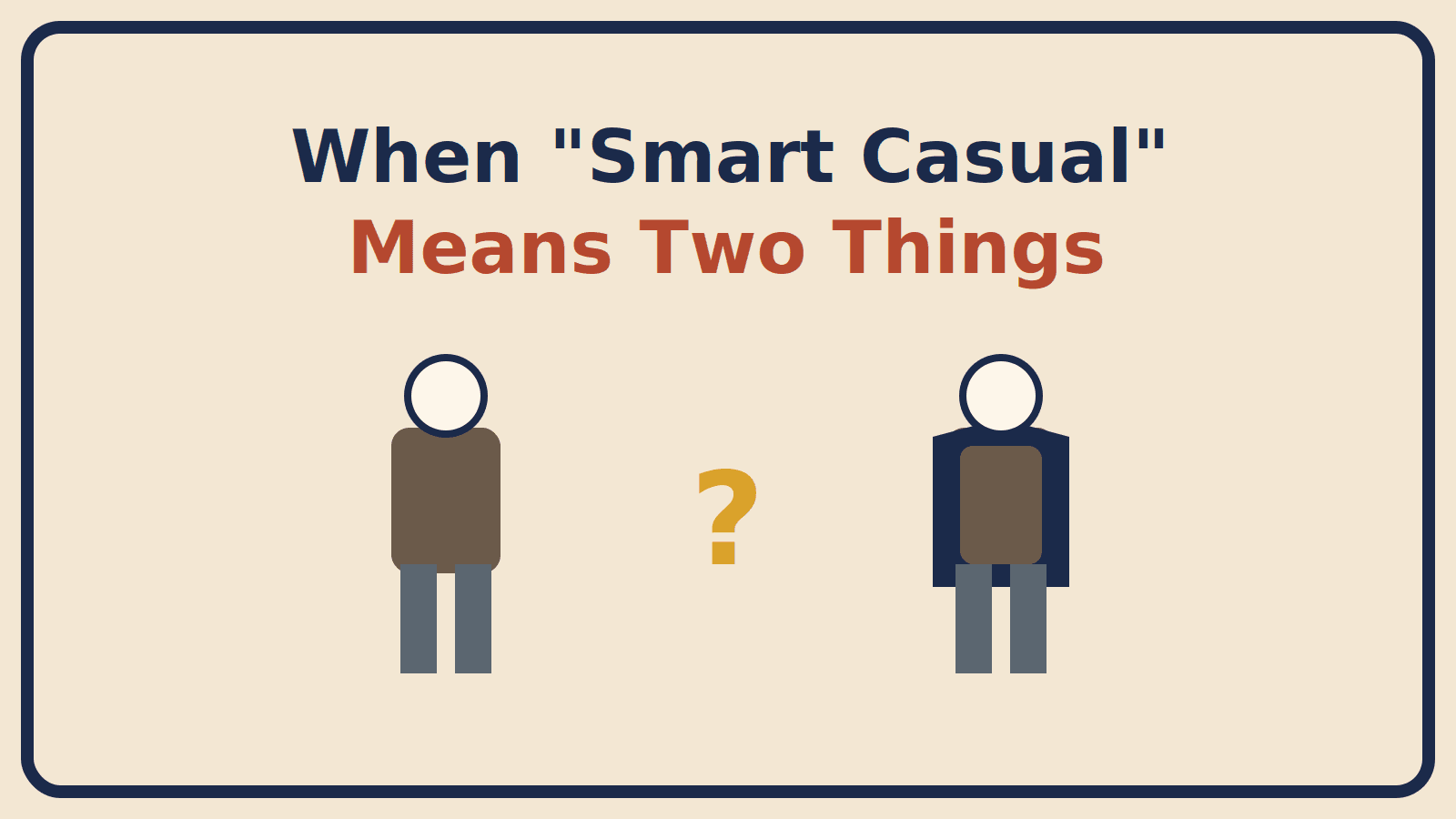
How to Pack for a Trip Where the Dress Code Is "Smart Casual" and Nobody Agrees What That Means
August 19, 2026 · 4 min read
Smart casual isn't a dress code with a hidden correct answer you failed to find, it's a genuinely contested term that even hosts, venues, and style guides define differently from each other. The practical fix isn't guessing harder, it's packing one outfit that reads correctly at both ends of the range.
Quick Answer
- Treat smart casual as a range, not a fixed rule, since sources genuinely disagree on where it sits
- Build a swing outfit around one piece, usually a blazer, that shifts the whole look dressier or more casual
- Dark, clean, well-fitted jeans work at most points on the range; distressed or baggy ones don't
- Pick shoes that split the difference: clean leather sneakers or loafers over both athletic shoes and formal dress shoes
- Ask the host if you can, but pack the flexible version anyway since even hosts disagree on their own wording
Why There's No Single Right Answer to Find
Most dress codes have a reasonably fixed meaning. Business casual, formal, and black tie all have widely shared expectations. Smart casual doesn't, and that's not a knowledge gap on your part, it's the nature of the term. Multiple independent style guides describe it as the single most confusing dress code that exists, precisely because it combines two words that pull in opposite directions and leaves the balance up to interpretation. One guide goes as far as calling it a stylistic blank check that can be cashed however the wearer likes.
The term also has a specific, narrower origin than its current use suggests. It originally referred to a lounge suit made in an unconventional color and a lighter, more casual fabric or cut, essentially a relaxed version of formal business attire. Over the decades that meaning drifted and loosened, which is part of why it now spans everything from a blazer over jeans to a full tailored look depending on who's using the term.
Because there's no fixed target, the packing strategy that actually works is building one outfit that can shift along the range rather than trying to pin down which specific point the host meant. A blazer is the most efficient swing piece for this: put it on over a collared shirt and clean trousers and you read as the dressier end, take it off and the same base reads as the relaxed end. This is the same logic behind packing for an unfamiliar dress code, just applied to a term that stays ambiguous even when you're not traveling anywhere unfamiliar at all.
Common Mistakes
People assume smart casual means business casual with the tie removed, but in practice that reads as overdressed at many smart casual events, since a full suit or a stiff blazer-and-slacks combination can look like you missed the "casual" half of the term entirely.
People assume smart casual just means casual with a nicer top, but in practice that undersells the "smart" half and can read as underdressed, particularly at restaurant or evening events where a bit more structure is expected. Wrinkled chinos, frayed jeans, or gym-adjacent fabrics fall outside smart casual in every interpretation, even the most relaxed ones.
People assume it's worth debating with travel companions which interpretation is correct before the trip, but in practice that debate has no resolution, since even professional style guides disagree with each other. The productive move is packing gear that covers the range, not settling an argument that doesn't have a winner.
Building the Swing Outfit
The core of a smart casual packing strategy is one base outfit with a single piece that changes its register. A navy or grey blazer over a clean, well-fitted shirt and dark trousers or clean dark jeans covers most interpretations on its own; adding the blazer nudges it toward the boardroom end, removing it nudges it toward the beach-and-boardroom-adjacent end that some guides warn against leaning too far into. Clean is doing a lot of work in every version of this dress code: fit, condition, and pressing matter more than any specific item choice.
Footwear works the same way. A clean leather sneaker or a simple loafer sits in the middle of the range and works whether the room leans dressy or relaxed, while both athletic sneakers and formal patent shoes miss the target in opposite directions. If you genuinely don't know which way a specific event will lean, the middle-of-the-range shoe is the safer packing decision of the two extremes.
Whatever the room decides smart casual means that night, JetKit's packing lists can build in a swing piece automatically so you're not packing two separate outfits just to hedge against an undefined dress code.
Frequently Asked Questions
What does smart casual actually mean?
There isn't one agreed definition, which is the source of most of the confusion. It generally sits between casual and business casual, but where exactly it lands depends on the venue, the region, and who wrote the invitation, so it's better treated as a range than a fixed rule.
How do I pack for smart casual if I don't know which interpretation applies?
Build one core outfit with a swing piece, usually a blazer, that you can add or remove. With the blazer on you read as the dressier end of smart casual, and without it you read as the more relaxed end, so you're covered either way without packing two separate outfits.
Are jeans okay for smart casual?
Dark, clean, well-fitted jeans are acceptable in most smart casual interpretations, especially paired with a blazer or a collared shirt. Distressed, light-wash, or baggy jeans read as too casual for almost any version of the dress code.
What shoes work for smart casual?
Clean leather sneakers, loafers, or minimal dress shoes all work depending on which end of smart casual the event leans toward. Athletic sneakers, flip-flops, and formal patent leather shoes both miss the range in opposite directions.
Should I just ask the host what smart casual means?
Yes, if it's practical to ask. But since even hosts and venues often disagree on their own definition, asking narrows things down without guaranteeing certainty, so packing a flexible outfit is still worth doing even after you ask.
JetKit is an AI app that builds your packing list automatically based on your closet and your trip.