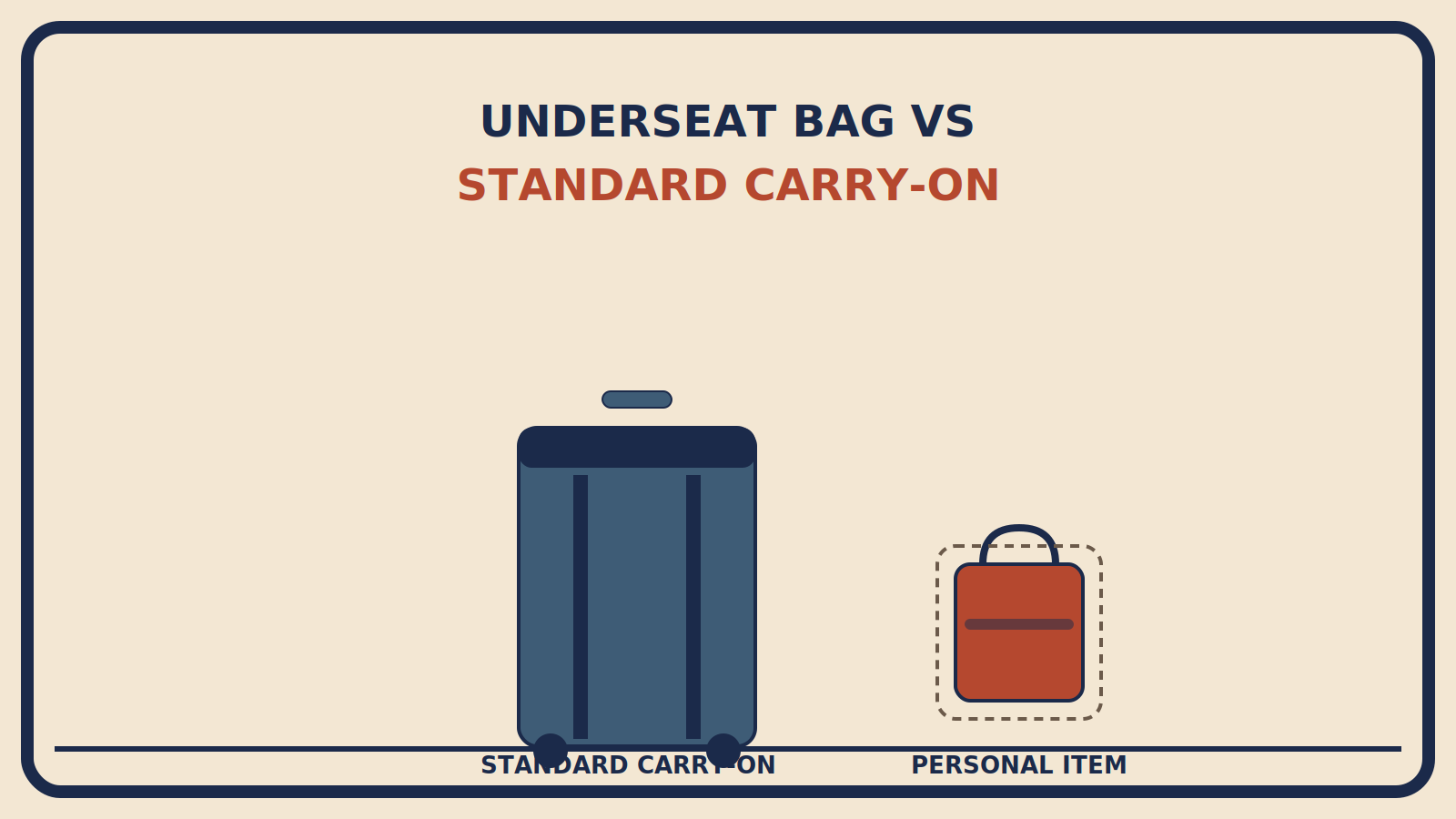
Underseat Bag vs. Standard Carry-On: What Actually Fits
July 24, 2026 · 4 min read
It really depends on how much you need to pack, since a personal item and a standard carry-on aren't competing for the same job. One goes in the overhead bin and disappears until landing. The other lives at your feet the entire flight and needs to hold whatever you'll actually want mid-air.
Quick Answer
- Personal item: purse, laptop bag, camera bag, tote, or small backpack that fits under the seat
- Standard carry-on: the overhead-bin piece, generally capped around 35 lbs and 10 x 16 x 24 inches
- Underseat dimensions vary by airline, so check before assuming your usual bag fits
- Personal item is where in-flight essentials belong: tablet, headphones, snacks, medication, charger
- Organization inside the bag matters more than the size limit itself
Why the Two Bags Solve Different Problems
A personal item is any small bag that fits under the seat in front of you, a purse, laptop bag, camera bag, tote, or small backpack all qualify. A standard carry-on is the bigger overhead-bin piece: a spinner suitcase, duffel, or backpack, generally capped around 35 lbs and 10" x 16" x 24", though that number shifts by airline. The size gap between the two categories is real and it matters: an item that clears personal-item dimensions on one airline can be too large on another, and going over means either gate-checking it or paying a fee, typically $25 to $35.
Underseat dimensions vary more than people expect. American Airlines, Frontier, and Spirit all cap personal items at 18" x 14" x 8". JetBlue runs slightly smaller at 17" x 13" x 8". Southwest allows 18.5" x 13.5" x 8.5". United is noticeably tighter on depth at 17" x 10" x 9". Delta's limit actually depends on the specific aircraft, since a regional jet's under-seat space can differ meaningfully from a larger plane's. If you're flying an airline or route you haven't flown before, it's worth a quick check rather than assuming your usual bag fits.
What goes in each bag matters as much as the size limits themselves. Since the overhead-bin carry-on isn't easily reachable mid-flight, the personal item is where the actually-needed-in-the-air stuff belongs: a tablet or book, headphones, snacks, any medication, a charger. Coats, pillows, and reading material typically don't count against either allowance, which is a small bit of extra room worth using if you're tight on space elsewhere.
Common Mistakes
People treat personal-item and carry-on limits as interchangeable across airlines. In practice, underseat dimensions genuinely vary, from United's tight 17 x 10 x 9 to Southwest's more generous 18.5 x 13.5 x 8.5, so a bag that cleared one airline's check-in can get flagged at the gate on another.
People pack a maxed-out carry-on assuming size alone solves the trip. In practice, organization is more important than the size of the carry-on. Two travelers with the exact same 22-inch spinner can have completely different experiences, one digging through a jumbled pile at security and again at the hotel, the other with everything zoned and reachable because the bag was packed with a system instead of just stuffed full.
People pack mid-flight essentials into the overhead-bin carry-on. In practice, that bag isn't easily reachable once boarding starts, so a tablet, headphones, snacks, medication, and a charger belong in the personal item instead, where they're actually within reach.
That's really the deeper packing problem underneath the size-limit question, and it's the same one worth solving for the carry-on itself, not just the personal item riding along with it. This piece on the best carry-on luggage for business travel picks up from here: once you know what fits, the next question is which bag actually helps you stay organized inside that limit rather than just meeting it.
A slightly smaller, well-organized bag beats a maxed-out one that's chaos to actually use, especially on a trip with tight connections or quick outfit changes. That's the kind of packing decision JetKit is built to help make, sorting what actually goes in each bag rather than just tracking whether everything technically fits.
Frequently Asked Questions
What counts as a personal item for a flight?
Any small bag that fits under the seat in front of you: a purse, laptop bag, camera bag, tote, or small backpack all qualify. It's a different category from a standard carry-on, which is the bigger overhead-bin piece like a spinner suitcase, duffel, or backpack.
How big can a personal item be on different airlines?
It varies more than people expect. American Airlines, Frontier, and Spirit cap personal items at 18 x 14 x 8 inches. JetBlue runs slightly smaller at 17 x 13 x 8. Southwest allows 18.5 x 13.5 x 8.5. United is noticeably tighter on depth at 17 x 10 x 9. Delta's limit depends on the specific aircraft.
What should go in my personal item versus my carry-on?
Since the overhead-bin carry-on isn't easily reachable mid-flight, the personal item is where the actually-needed-in-the-air stuff belongs: a tablet or book, headphones, snacks, any medication, a charger.
What happens if my personal item is too big?
Going over the size limit means either gate-checking it or paying a fee, typically $25 to $35. An item that clears personal-item dimensions on one airline can be too large on another, so it's worth checking rather than assuming your usual bag fits on a new airline or route.
Does a bigger carry-on always mean a better packing experience?
No. Organization matters more than the size of the carry-on. Two travelers with the exact same 22-inch spinner can have completely different experiences, one digging through a jumbled pile at security and again at the hotel, the other with everything zoned and reachable because the bag was packed with a system.
JetKit is an AI app that builds your packing list automatically based on your closet and your trip.