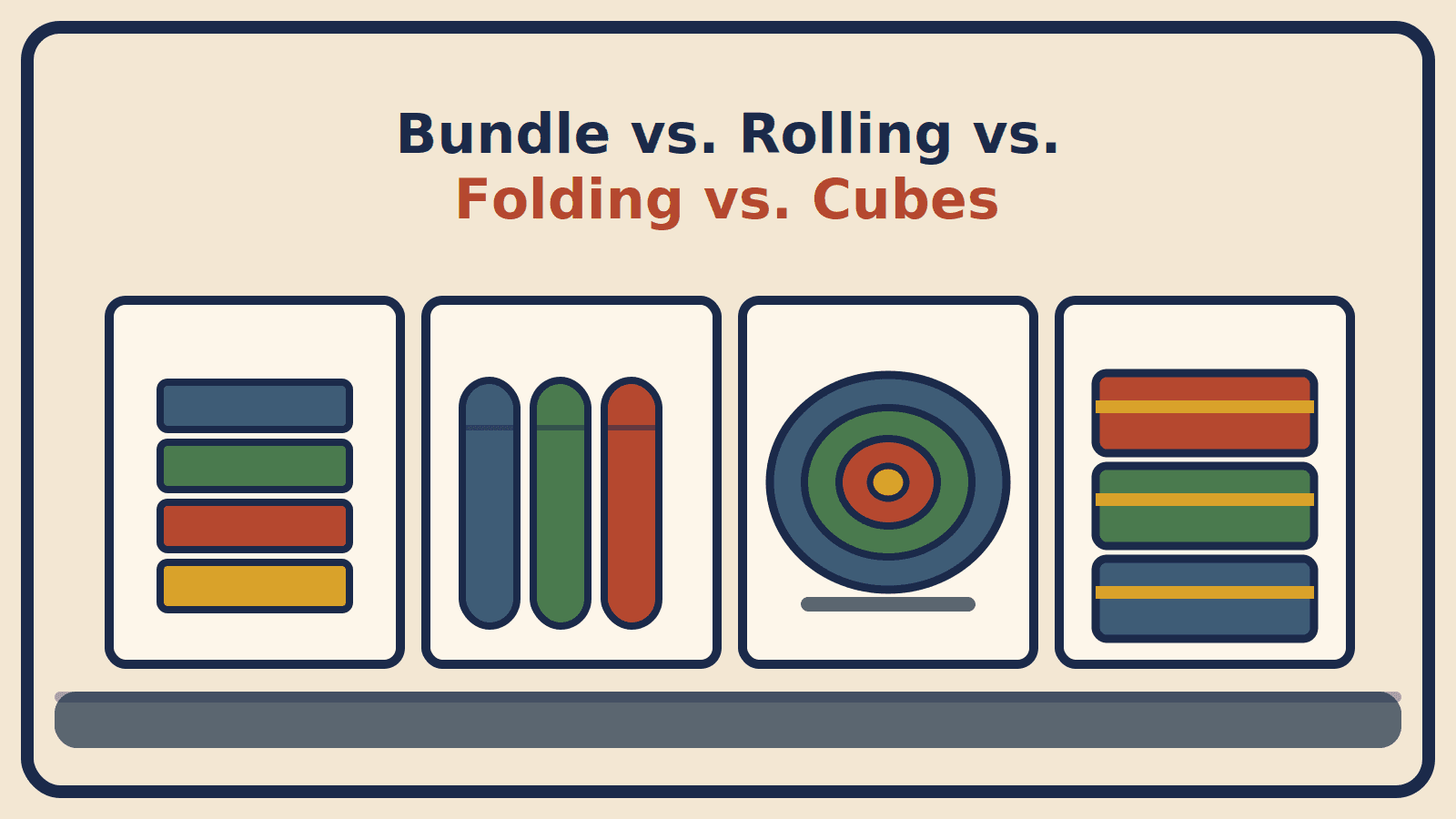
Best Packing Methods Compared: Bundle Wrapping vs. Rolling vs. Folding vs. Cubes
August 18, 2026 · 5 min read
Bundle wrapping, rolling, folding, and packing cubes aren't actually competing for the same job. Folding and rolling are volume techniques, bundle wrapping is a crease-prevention technique, and cubes are an access system layered on top of whichever of the first three you choose. The right pick depends on your bag shape, your wardrobe, and whether you're optimizing for space or for arriving wrinkle-free.
Quick Answer
- Rolling usually wins on raw volume and is good at filling irregular gaps around shoes and toiletries
- Folding is the simplest method but leaves air pockets and a sharp crease at every fold line
- Bundle wrapping wraps garments around a soft core so nothing creases against itself, best for suits and structured dress clothes
- Packing cubes organize access, they don't compress your load unless they're specifically compression cubes
- Most experienced packers combine methods: fold or roll clothes, then sort them into cubes, rather than treating these as four rival systems
Why the Four Methods Solve Different Problems
Folding and rolling both manage volume, but they do it differently. Folding leaves small air gaps at every crease and concentrates stress at one sharp fold line per garment, which is where visible creases tend to form. Rolling removes most of those air gaps and usually wins on raw volume, but it compresses fabric continuously along the entire length of the roll instead of at a single point.
Bundle wrapping is a different category of technique entirely. Popularized by Doug Dyment on onebag.com, and described by Judith Gilford's The Packing Book under the name "bundle folding," the method wraps garments in layers around a small soft core, usually a stuff sack or a bag of smaller items. Because nothing folds against itself, there's no sharp crease line at all. This is a crease technique, not fundamentally a volume technique, even though it's often marketed on space savings.
Packing cubes solve a third, unrelated problem: access. A standard cube doesn't compress anything, and it adds a small amount of its own fabric weight to your bag. What it does is turn a suitcase into a set of labeled drawers, so you're not unpacking the whole bag to find one shirt. Only compression cubes, the ones with a second zipper that squeezes air out after closing, actually reduce volume, and that compression comes at the cost of more visible creasing since the garments inside are held under continuous pressure.
Common Mistakes
People assume rolling always wins on space, but in practice a hands-on Apartment Therapy trial found the opposite in a hard-shell case: the bundle took up more depth than the rolled clothes, and the writer reverted to rolling. This is because a bundle is one large, dense mass that suits a deep, firmly packed bag, while rolled items are small individual units that are good at filling the irregular gaps left around shoes and toiletry bags. Which technique "saves space" depends on the bag's shape and what else is in it, not just the technique itself. For a closer look at rolling versus folding specifically, see our breakdown of which one actually saves more space.
People assume packing cubes compress their load, but standard cubes don't reduce volume at all, they only organize it. Compression is a separate feature found only in cubes with a second zipper built for squeezing air out, and using that feature means accepting more creasing in exchange for the space.
People assume bundle wrapping is fragile or overengineered for a real trip, but the actual failure mode is more specific than that: a bundle that gets moved and repacked repeatedly tends to come loose and lose its advantage. It's a strong choice for a bag you pack once and don't touch again until you unpack, and a weaker one for a trip with nightly hotel changes.
What the Comparisons Actually Show
The space-savings claims around bundle wrapping are a genuine published conflict, not a settled fact. Onebag.com claims bundling beats both folding and vacuum bags on volume, and other sites call it the best method "in all aspects." But the Apartment Therapy hands-on trial found the opposite in a real suitcase. Both can be true at once: a bundle is one large mass that suits a deep, firmly packed hard case, while rolling produces small units that are better at filling gaps around irregularly shaped items. Neither of these is a controlled study, they're single-person trials with one wardrobe and one suitcase, so treat the specific numbers loosely and the underlying mechanism as the reliable part.
The one finding that holds up more consistently across sources is on wrinkles, not space. An informal editor comparison across five packing methods found bundle wrapping produced the fewest wrinkles and rolling produced the most, which lines up with the mechanism difference above. It's also worth noting that onebag.com's own writeup includes a caveat that enthusiastic summaries tend to leave out: a bundle that shifts or gets partially unpacked mid-trip loses its structure fast. Firsthand accounts on travel forums back this up, noting that bundling works best with longer garments that stay put in the bag rather than trips involving nightly repacking.
Whichever method you land on, the real decision is less "which technique wins" and more "which problem am I solving for this specific trip." JetKit's packing lists factor in your trip length and bag shape so you're working from a list built for the packing method you're actually going to use, not a generic one.
Frequently Asked Questions
Does bundle wrapping actually save more space than rolling?
It depends on the bag and the contents. Bundle wrapping produces one large, dense mass that suits a deep, firmly packed hard-shell case, while rolling produces small individual units that fill irregular gaps around shoes and toiletry bags. A hands-on trial from Apartment Therapy actually found bundling took up more depth than rolling in their suitcase, even though sites like onebag.com claim the opposite.
What's the difference between packing cubes and compression cubes?
Standard packing cubes organize your bag into grab-and-go sections but don't reduce volume, and they add a small amount of their own fabric weight. Compression cubes have a second zipper that squeezes air out after you close them, which is the only version of a cube that actually saves space.
Which packing method causes the fewest wrinkles?
In an informal five-method editor comparison, bundle wrapping produced the fewest wrinkles and rolling produced the most. This tracks with the mechanism: bundling avoids sharp fold lines by wrapping garments around a soft core, while rolling compresses fabric along its entire length.
Can I combine rolling and packing cubes?
Yes, and it's how most experienced packers actually use cubes. Roll or fold your clothes first to manage volume, then sort the rolled items into cubes by category or day so you're not repacking your whole bag to find one shirt.
Is bundle wrapping only good for suits and dress clothes?
It's best suited to structured or wrinkle-prone garments like suits, blazers, and dress shirts, since the technique's whole point is avoiding creases. It works less well for trips with nightly hotel changes, since a bundle that gets moved and repacked repeatedly tends to come apart and lose its advantage.
JetKit is an AI app that builds your packing list automatically based on your closet and your trip.